
Having the fastest printers or the most skilled fabricators and fitters can all be undermined if you have bottlenecks or inefficiencies within the business, or if you don’t really know what jobs cost to produce. These are the kinds of problems that software such as MIS and workflow is designed to solve. Michael Walker explains.
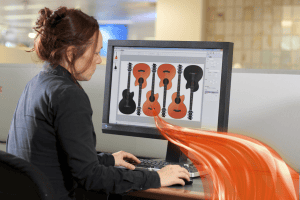
Agfa Asanti Production
MIS (management information systems) were originally developed to help with estimating, ordering and inventory or stock control. Since then they have added integration with production workflow systems, logistics and accounting tools, plus cost and profitability analysis, with some offering business intelligence (BI) capabilities.
Workflow grew out of prepress, centring on the preparation and processing of digital artwork, including pre-flighting of files, colour management, imposition, tiling, ganging or nesting. It has extended downstream, allowing print and finishing parameters to be passed to suitably automated equipment, such as digital cutting tables, and for machine status to be passed back up the line for true job costing and pre-emptive maintenance scheduling.
Web-to-print/e-commerce is increasingly integrated with both MIS and workflow, such that it’s hard now to see where one ends and the others begin. Integration between these components is also increasingly possible – and desirable, as experience has shown that no one single-vendor system can meet all needs.
Another major trend is the move to cloud-based computing and SaaS (software as a service) subscription-based pricing. These make software offerings more attractive as you don’t have to have hefty servers in-house to run them and software updates are performed automatically. Some offer pricing based on usage, and can usually be scaled up quickly to support business growth.

Steve Richardson, Optimus
A long-time player in the MIS camp is Optimus, whose Group Commercial Director Steve Richardson is at pains to point out that the software doesn’t only support highly digitised production operations such as wide-format digital printing, but can be extended to the more manual processes involved in bespoke fabrication.
‘There are possibilities for automation, whether it’s managing a raw bill of materials or manufacturing [the] screens for printing,’ he argues, adding that ‘Some standardise only 50% of their jobs or processes to start with, then after two years, we find they’re up to 90%.’
Optimus allows extensive configuration, working from a ‘lean manufacturing’ perspective, and can integrate with other software such as Enfocus Switch via XML. However, the company is bucking the Saas trend, charging for the licence, for installation and for maintenance. Mr Richardson explains that some smaller providers who offered the SaaS model have come and gone, and points out that ‘MIS and workflow are business-critical. They need to be defined and maintained. It’s not plug-and-play.’
PrintIQ also supports a wide range of print types, and covers everything from estimating and ordering to production, delivery and invoicing. It too can integrate with web-to-print, prepress automation, accounting systems and shipping platforms. An integration with Infigo web-to-print was announced in 2023 and Rob Thurston, UK Sales Manager at PrintIQ, comments, ‘We are open to many integrations within web-to-print and beyond. Ultimately, we want to streamline our customers’ processes and provide control and visibility within their business.’
The release in summer 2024 of v48 of PrintIQ added new capabilities including gang-based estimating for complex quotes in both roll and sheet-fed printing, and the addition of a new orders board for quick visibility of large orders, while reporting has been made a single-click process. Store and inventory functions have been updated and automated purchase order generation has been added.
On the workflow side, the options are more focused around wide-format digital print, with printer vendors such as Agfa and Durst offering software to support their own printers and third-party ones. The EFI range is supported by both its and eProductivity Software’s (EPS) offerings thanks to the companies’ history as a single entity. Machine-agnostic workflow products also come from RIP developers Onyx and Caldera, which both support very wide ranges of digital printers and cutters.
Another option here is PrintFactory, which in addition to carrying out prepress tasks, with particular emphasis on colour management, provides real-time data on production performance, enabling users to identify inefficiencies and optimise operations. The software collects and analyses data on ink usage, media waste and machine downtime to support informed decisions. This also enables predictive maintenance, reducing unscheduled downtime.
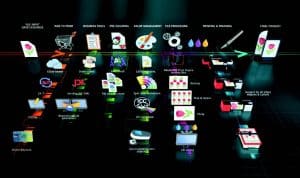
Agfa Asanti overview
Agfa’s Asanti workflow for wide-format print offers automation features such as pre-filling roll or sheet media with nested or step-and-repeat artwork to maximise use of the material, plus hot ticket/folder workflow and the ability to interrogate PDF artwork to establish output size and route jobs accordingly.
Asanti doesn’t just drive Agfa’s own printers, it can send PDFs that include cutting paths to anyone else’s devices. ‘Think of it as a planning tool,’ explains Agfa’s UK inkjet systems specialist Graham Clark, noting that while many designers prepare artwork for print in Adobe Illustrator, manually duplicating and aligning elements for step-and-repeat or adding cutting paths, Asanti can handle this aspect of the work automatically. ‘It’s about producing the greatest amount of work in the least time,’ he says.
Sitting somewhere between workflow and web-to-print is OnPrintShop, which VP Sales Naimish Patel describes as ‘a comprehensive web-to-print and print order management solution’ that offers ‘a holistic ecosystem designed to streamline sales, order processing and production while remaining focused on enhancing customer experience’.
This software offers dedicated workflow for job management, order tracking and production management, plus dynamic pricing and estimating tools for several print segments; these include digital wide-format, signage and banners and canvas and wall art applications. In addition, OnPrintShop offers inventory integration for larger printers relying on real-time stock management, and automated production routing according to job type, as well as integration with shipping service providers.
Other players that cross over between the categories include PrintPLANR and Hexicom. The former is a cloud-based MIS that includes W2P and sign estimation modules. It’s claimed to cover CRM (customer relationship management), quoting, job management, dispatch, inventory and Invoicing modules.
Hexicom is also a cloud-based offering print MIS and web-to-print capabilities, with sign estimating and online print ordering components. Like all cloud-based systems, it allows access from anywhere with an internet connection. It can create both detailed work orders/job tickets for production staff, and supplier purchase orders, delivery dockets and customer invoices.
This isn’t an exhaustive list of MIS and workflow options, but it should be clear from the issues they address that there is plenty of scope for improving overall productivity and profitability across the business by using the people, hardware and materials together in the most efficient ways, driven by the data.