

White ink is useful because it’s opaque
In this article, Jamie Reader, sales consultant at Granthams GT, discusses how you can introduce white ink
to your working day and why you should.
As manufacturers respond to the demands of their client base, the facility to introduce white ink to your next printer has steadily become more affordable and less pain-staking, leading to more print departments looking to bring the service in-house.
If you’re looking to invest in a large format printer capable of printing white ink, you’ve most likely come across a wide range of different technologies, brands and variations.
In this article I aim to compare three of the most recognised technologies in the signage industry – solvent, latex and UV – in order to better understand what benefits each ink can bring to the table.
Why introduce it?

By adding white ink, a solid foundation is created for standard colours to stand out
So, let’s get stuck in… first off, why would you consider introducing white ink into your printer?
White ink is useful because it’s opaque, whereas the standard colours that make up a printer are transparent. By printing an opaque white ink onto a clear or even a pre-coloured substrate, it creates a solid foundation for standard colours to stand out.
For these reasons, white ink is typically favoured by sign makers for producing window graphics applied to the inside of a window.
Solvent printers configured with white ink
Solvent still remains extremely popular in the sign making and vehicle graphics industry, and for good reason. Solvent printers are renowned for their wide colour gamut. As a result, solvent is still a go-to solution for clients who need to achieve specific pantones.
A high percentage of pantones can still be accomplished with latex and UV ink, but high contrast colours (reds, oranges, greens for example) are harder to match.
While solvent technology continues to grow and improve, solvent white ink still suffers from being:
- More expensive to run due to a higher cost per millilitre and due to more frequent cleaning cycles.
- The white ink also requires more agitation than other inks, and as a result demands more maintenance to reduce the risk of clogs and blocked nozzles.
- Running white ink is a slow printing process due to the nature of the ink and the time needed to cure properly.
- Ignoring the print speed, users would still be unable to offer same-day turnaround due to the ink needing to ‘gas off’ appropriately (usually 24 hours) before it’s cut, laminated or applied to avoid shrinkage, curling or adhesion issues.
- Finally, solvent white ink is less opaque than the alternatives, and as a result, less punchy when presented on a darker surface.
For those who decide to introduce their solvent printer to white ink, our typical advice would be to run the white ink regularly to help with circulation.
With that in mind, the rest of this article focuses on the features and differences between latex and UV, both of which are instant cure technologies, allowing you to offer clients a same-day turnaround.
Advantages of UV configured with white ink
Starting out with UV, this has long been the more popular route for sign makers expanding into window graphics.
The UV range is available in multiple different sizes to suit the user (these are typically 30in, 54in and 64in) and is also available at different tiers to suit lower volume and high production print studios as well as clients wanting to offer spot UV effects or print to an unconventional substrate.
UV is cured without any heat using permanent LED Lamps, resulting in much lower energy consumption and the ability to print on more heat-sensitive stock. It’s also an extremely versatile ink, which can adhere to virtually any substrate so long as it feeds through and isn’t too porous.
UV also has the fastest production speed available when printing white ink. Other technologies do still stand out when it comes to your typical colour printing, but if white is a key component for you multi-layer print speeds are a step ahead.
These printers are also available with an integrated vinyl cutter to reduce investment as well as floorspace – this can be especially important if you’re working in a confined print room and don’t have space for two separate machines.
Because UV ink is cured as it prints, it is capable of printing any number of layers in order to achieve textures, braille effects and unique double-sided graphics. With the addition of an optional clear varnish, you can also offer spot UV effects with a high-contrast gloss or matte finish to make certain areas of your graphics really stand out.
Advantages of latex configured with white ink
If we turn our attention to latex, one of the most valuable assets is the ink itself. Latex ink is a water-based, non-toxic ink that is completely odourless with the lowest carbon footprint. This environmentally conscious approach is often preferred by schools, hospitals and government bodies, especially for interior displays, as there are no restrictions or odours to worry about.
Replaceable print heads remove the need to perform regular cleaning procedures, which are usually required to maintain a permanent print head, which is at risk of ink build-up and blockages over time. With a replaceable print head, these can be simply popped in and out when there are any signs of a drop in quality.
The white print heads can also be removed and ‘parked’ when they’re not being used for prolonged lengths of time, reducing unnecessary waste that would otherwise take place during cleaning cycles.
Latex ink has a very high elasticity, making it an ideal solution for vehicle graphics and full wraps.
The ink can be layered and is capable of printing up to five layers to achieve unique double-sided graphics, or three layers (also known as a sandwich layer) in order to present the same graphic on both sides.
Although a separate vinyl cutter would be required to produce decals and stickers, the latex printers are front-loading, which means the printer doesn’t need additional space for rear access and can be positioned up against a wall.
Finally, latex ink claims to offer the ‘whitest white’ ink available, which isn’t susceptible to yellowing over time.
UV vs latex – the results
UV vs latex
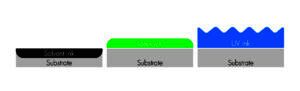
From a visual perspective, the difference between the UV and latex will depend heavily on the substrate and types of graphics you plan to print. UV ink will sit on the surface of the material, enabling textured finishes but also leaving a consistent matt finish.
Latex ink also sits on the surface, but the water used to carry the colour pigments and latex particles is evaporated under high heat, leaving a thinner layer that adopts the finish of the substrate.

Latex vs UV
If the natural finish of UV ink isn’t something you can live with, it can be cloaked by applying a gloss over-laminate film to your printed vinyl, which would require a separate roll-fed laminator. Over-laminates also increase the longevity of prints, especially those being displayed outdoors.
Whether it’s solvent, latex or UV, unlaminated prints exposed to the elements are likely to start fading
after nine to 12 months as a result of UV exposure and weathering – the application of over-laminate can increase this from three years all the way up to seven years (depending on the grade of vinyl and laminate used).
If you expect your main application to be window graphics, the finish of UV shouldn’t matter too much given most window displays are printed in reverse and applied to the inside of the window.
The matt finish of UV ink won’t be recognisable through glass and plays no part in the overall quality or durability of the print.
I hope this article was useful, but if you have any further questions please get in touch.