
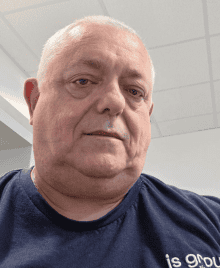
Rob Hogarth
In a celebration of almost 50 years of loyalty to the sign industry, we speak to Rob Hogarth, a true veteran of the industry who saw an almost fantastical transformation from traditional sign writing to modernised printed signage.
When Rob Hogarth began his career in the sign industry in June 1978, most signs were still produced by hand; no vinyl, no automation just sign writers working with brushes, paints, steady hands, and years of skill.
A lot has changed during the estimating manager’s career, but after 48 successful years within the industry, he has decided to hang up his boots.
It all started with his first role at Pearce Signs NE, before moving on to Astley Signs in 1988. 10 years later, he made the move to Graphex Rivermeade Signs, where he stayed until 2008, when he made the change to Saltwell Signs.
The company was later bought out by Astley Signs in 2010, where Rob once again stayed until 2017, when he joined his last company Jonsigns, where he remained until his retirement this year.
Learning the trade
Rob left school having never heard of any sign companies.
“We didn’t have the internet to look up and research any company back then, so I went into the interview open-eyed. I had an accident the week
before, breaking my nose and losing my 2 front teeth as I went head over heels on my bicycle.
“I was helping the local newsagent deliver papers, which I had done years before, and often wonder if I was taken pity on when I got the job starting on
£25 per week.
“My first task was to input the hours on individual job cards by hand using different coloured ink for time and a third, time and a half, and double time. After several months I was told I had passed my probation and went up to £27.50 per week.
“The sign industry taught me patience and precision. Every mistake was visible to the public, so quality mattered. Experienced craftsmen took pride in their work, and I was fortunate to learn from people who valued excellence.”
Over the next few years, Rob progressed to the production department and worked out the piecework rates for the shop floor, a bonus that they earned
if the job was completed on time.
This gave Rob the grounding needed for this next step – estimating, but as much as experience helps gain knowledge, it soon became apparent that more knowledge would be needed to keep ahead of the industry.
The industry evolved
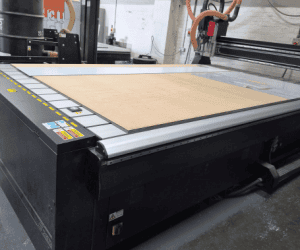
CNC router in action at Jonsigns
The biggest change Rob witnessed within the industry was the shift from hand-drawn artwork to computer-generated design.
He said: “Computers were unheard of in our trade, and every letter was measured and painted with care. Little did I know that I would witness one of
the greatest transformations any industry could experience.”
“What once took days could eventually be completed in hours, yet the need for creativity and attention to detail remained unchanged.
“Vinyl lettering then became available; neon and fluorescent tubing within lettering and box signs were replaced with LEDs, although you can still get
neon tubing today.
“Flexface boxes became more commonplace as signs got bigger, and all of these new processes had to be learnt to provide an accurate specification and quotation to the customer.”
Memories
Over the years, Rob has worked with a great deal of customers and suppliers, gaining knowledge of materials, as well as ageing methods for brass and copper. He also had many anecdotes to tell and recalled a more amusing discussion between him and a customer whose sign had given the window cleaner a shock.
He said: “The window cleaner reported it to the front desk and they sent someone up the ladder and they got a shock too.
“I was asked, ‘What should we do?’ and dryly I replied, ‘Stop going up the ladder and turn the fireman’s switch to the off position’.”
Another customer request was about a pet store’s sign that had malfunctioned.
He continued: “A pet store had a dog on a flasher sequence, which went awry and looked like two dogs having a bit of fun. The owner had a visit from a council official and was told to get it repaired, or he could get prosecuted under the Obscene Publications Act.
“When we went to fix the sign, the flasher unit had been knocked, and the speed was reset. The owner was disappointed as he said sales had gone
up threefold by people coming in to say what was wrong but ended up leaving with a purchase they never intended making.”
Another project Rob mentioned that he was “extremely proud” of was the Jurys Inn Glasglow which won the architect an award, but he swiftly added he received no such recognition.
Rob said: “I have been involved with many major contracts, from Halifax Building Society as it was then, The Emirates Stadium in London, Papa
Johns, Pepes, William Hill to name but a few.
“Going back to my early career, I used to apply the vinyl on the WD & HO Wills nameboards, earning 50p per board on a Friday afternoon to make a little bit more money.”
Career highlights
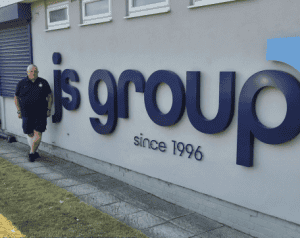
Rob at Jonsigns’ Gateshead workshop
Rob also talked about the career highlights that had stuck with him throughout the years.
“Where do I start?” he said. “From corporate rebrands and upgrades, Farmfoods was one of the biggest I have been involved with, each site being
different although most of the signs are the same.
“The colourful Great North Children’s Hospital I still like to this day, Hilton Hotel in Gateshead, watching how it was like a large Lego site being stitched together.
“My last employer, Jonsigns, have grown steadily over the last nine years, and we have also invested in a powder coating and stove enamelling plant,
and a laser cutter, bringing all signs manufactured under our own control and in-house.”
Advice to the next generation
With a varied and long career, Rob’s experiences within the industry are invaluable to the next generation of sign makers.
He commented: “Learn the technology, but don’t forget the fundamentals. Good design, quality workmanship, reliability, and pride in your work will always be valued, regardless of how the industry changes.
“Specify each sign so that the customer knows what they are getting in an easy-to-understand format. Too often I see quotations from other companies, and you could drive a bus through it. How they get away with it, I don’t know.”
“A lot of the time the signs are the last thing to be installed or thought about when a new building is nearing completion, and as it has gone over budget they then expect a reduction in the sign costs or to re-value and re-engineer them to bring costs down.”
Rob also mentioned that respecting your work colleagues is important, but also investing in a pension is too – he is “glad” that he has it as he is having to retire early for health reasons.
Every career has its obstacles; more signage companies arriving on the scene add to the competition, and the changing technology and trying to keep up with it or stay ahead can be challenging at times.
But for Rob Hogarth, he seems happy to have had the experiences he has, and now with his whole future ahead of him, one day he’ll look back and remember fondly.

